Gabrielle Argueta · Instructional Designer
Skip to content

Hi, I'm Gabby

{{ roleTitle }}

Complex topics, made clear.

I build learning experiences for professionals, grounded in learning science and designed for real-world impact.

View my work
Portrait of Gabrielle Argueta
accredited online courses designed
25+
learner satisfaction (2025)
4.88 / 5
iSpring Course Creation Contest
2026 winner
all courses meet WCAG
2.2

{{ gridTitle }}

Leadership development, professional legal education and science communication. Select a project to see the process behind it.

{{ countLabel }}

All work

Featured Project

Leading Through Change

This project explores how immersive learning can support managers navigating organizational change by strengthening confidence, judgment, and communication during moments of resistance.

Leading Through Change is a 360° scenario-based eLearning experience that places learners in the role of a manager navigating team resistance to AI adoption.

Built in Articulate Storyline 360, the project combines immersive environments, non-linear exploration, and decision-based interactions to help learners practice real-world leadership skills.

Open course full screen (opens in a new tab)

Interactive course. Click and drag to look around each 360° scene, or open it full screen.

Target Audience

Intermediate-level people managers responsible for leading teams through organizational change, particularly the adoption of new technologies like AI.

The Solution

A 360° scenario-based learning experience that allows managers to practice addressing resistance through realistic conversations, decision-making, and guided feedback in a safe environment.

The Challenge

Many change management trainings focus on theory, leaving managers unprepared to navigate real-world resistance, emotional responses, and ethical concerns during transitions.

Tools Used

Developed using Articulate Storyline 360, with visuals created in Canva and Skybox AI, and AI tools supporting ideation, content refinement, and workflow efficiency.

The Challenge and The Solution

The Challenge

Managers are expected to lead change, but often struggle with the human side of adoption, especially with AI.

Common gaps

  • Resistance shows up as fear, skepticism, and job security concerns
  • Training is often theory-heavy, not practice-based
  • Managers lack experience handling real conversations

Result: Managers may over-explain, dismiss concerns, or push too quickly, increasing resistance instead of reducing it.

The Solution

A 360° scenario-based experience where learners practice leading change conversations in a realistic environment.

Key design elements

  • Role-play as a manager navigating AI adoption
  • Engage with multiple team perspectives
  • Make decisions and receive immediate feedback

Outcome: Learners build confidence and practical communication skills they can apply in real-world situations.

Design approach: Create meaningful decision points with real outcomes to mirror the ambiguity leaders face during change.

My Design Process

Each phase focused on aligning realism, learner autonomy, and behavioral outcomes with the goals of change adoption.

  1. Step 1: Define & Refine
    • Define learning goals, audience, and core skills
    • Use AI to brainstorm and refine the concept
    • Create initial design document
  2. Step 2: Design the Experience
    • Develop storyboard using AI + iteration
    • Refine interactions, dialogue, and flow
    • Incorporate feedback to improve realism
  3. Step 3: Develop Visual Assets
    • Generate 360° environments with Skybox AI
    • Create characters using AI tools
    • Design UI and static visuals in Canva
    • Refine visuals with intern support
  4. Step 4: Prototype & Validate
    • Build Scene 1 prototype in Storyline
    • Test interactions and 360° functionality
    • Validate design before full development
  5. Step 5: Build & Iterate
    • Develop full course in Storyline 360
    • Implement variables, triggers, and layers
    • Refine navigation, feedback, and user experience

Define & Refine

I began by defining the learning goal, target audience, and core skill the experience needed to address. Using AI as a thought partner, I refined the project concept, explored scenario possibilities, and developed an initial design document to establish a clear instructional direction. This phase ensured the experience was grounded in real-world application and aligned with meaningful learning outcomes.

Design intent: Define behavioral outcomes early to ensure the experience supports real-world decision-making.

Screen recording: drafting the storyboard (no audio)

Design the Experience

I translated the concept into a detailed storyboard that mapped the learner journey, interactions, and decision points. AI supported initial structure and idea generation, but I refined the flow, dialogue, and feedback to ensure realism and instructional alignment. I also incorporated feedback to strengthen the narrative and create a cohesive, scenario-driven experience.

My goal in this phase was to create a learner journey that felt authentic, emotionally grounded, and directly tied to change-related challenges.

Screen recording: scrolling through the storyboard (no audio)

Develop Visual Assets

To create an immersive environment, I generated 360° scenes using Skybox AI and developed supporting visuals, including characters and UI elements. I designed all static assets in Canva and delegated select image refinements to an intern to enhance visual clarity. All assets were reviewed and prepared for integration into the course.

Visual choices were selected to reinforce realism and place learners inside environments where change conversations naturally occur.

Screen recording: generating a 360° scene in Skybox AI (no audio)
Screen recording: editing visual assets in Canva (no audio)

Build & Iterate

I developed the full course in Storyline using variables, triggers, and layers to create dynamic interactions and control navigation. I implemented a gated, non-linear structure to guide learners through each scenario while maintaining autonomy. Throughout development, I refined feedback, interaction clarity, and user experience to ensure the final product was both engaging and instructionally effective.

Iteration focused on clarity, cognitive load, and ensuring every decision point had meaningful instructional value.

Storyline 360 workspace showing the 360° hallway slide, its triggers, and slide layers such as Already Visited and Instructions

Project Files

Project Takeaways

This project challenged me to shift from designing content to designing experiences.

What I Learned

  • Content → Experience

    Rather than focusing on what learners should know, I focused on what they should do, creating opportunities for decision-making, reflection, and real-world application.

  • Designing for Complexity

    It also deepened my understanding of how to design for complexity. Building a non-linear, scenario-based experience required intentional structure, ensuring learners had the freedom to explore while still being guided toward meaningful outcomes.

  • Intentional AI Use

    Throughout the process, I became more intentional in how I use tools, including AI, within my workflow. I learned to balance efficiency with thoughtful design decisions, using technology to support, not replace, instructional thinking.

What's Next

Initial user testing informed several refinements to navigation and feedback, strengthening the overall learner experience.

  • Branching scenarios

    Create more dynamic, consequence-driven learning paths, allowing learners to see how different approaches impact team outcomes over time.

  • Expanded keyboard navigation

    Continue improving accessibility so the experience is fully operable for all users.

  • Less reliance on 360° interactions

    Reduce reliance on 360° interactions where possible, ensuring the experience is more inclusive.

Project Impact

Projected Impact (If Implemented in an Org):

  • Increase: Manager confidence when navigating resistance.
  • Increase: Quality of decision‑making during change conversations.
  • Decrease: Escalations and misunderstandings during transitions.
Open course full screen (opens in a new tab)
All work

Branching eLearning · iSpring Suite

A New Manager's Playbook: Know, Support, Lead

iSpring Features Pro Nomination Winner, iSpring 2026 Course Creation Contest

Client: Solara Health Consulting (fictional healthcare consulting firm created for the iSpring 2026 Course Contest)

Open course full screen (opens in a new tab)

Interactive course. Use the player controls, or open it full screen.

Target Audience

Newly promoted or externally hired people managers with strong individual contributor backgrounds and limited formal management training, completing self-paced eLearning during their first two weeks in role.

Format

Slide-based eLearning | iSpring Suite | 20–25 minutes | SCORM-enabled

My Role

Sole instructional designer and developer. Responsible for needs framing, learning objective development, interaction design, visual design, narration scripting, AI audio production, job aid creation, and full iSpring build.

Tools Used

iSpring Suite, Microsoft PowerPoint, ElevenLabs (AI narration), Canva (job aid), Claude (AI writing and content development), SCORM

Overview

This course addresses one of the most challenging transitions in any organization, moving from individual contributor to people manager. Set at Solara Health Consulting, learners follow Alex Rivera through her first 30 days as a newly promoted Engagement Manager. The course is grounded in two evidence-based leadership frameworks, servant leadership and coaching vs. directing, woven intentionally throughout the design rather than presented as standalone content. The course was recognized as the iSpring Features Pro Nomination Winner in the iSpring 2026 Course Creation Contest.

Highlights

  • Three-branch scenario placing learners in Alex's first 1:1 with a disengaged team member, with distinct consequences for avoidance, premature directing, and coaching
  • Six iSpring interactions are distributed across 17 slides, including tabs, media catalog, accordion, cyclic process, matching, and branching scenario
  • Downloadable 30-Day Listening Tour job aid attached via the iSpring Resources panel
  • A dual-layer design approach presenting each team role alongside the specific support the manager owes that person
  • AI-generated narration with learner-controlled closed captions and free navigation throughout

Project Files

Reflection

The strongest design decision in this project was the pivot away from an active listening topic early in the process. Reframing around new manager onboarding produced a tighter instructional problem, stronger alignment with real L&D job postings, and a more cohesive scenario. The leadership frameworks came from my own FSU Leaders in Training cohort experience, which made the content feel grounded rather than generic, and that authenticity carried through every interaction and piece of feedback in the course.

All work

Executive education · Rise 360 + Canvas

Fundamentals in Employment and Human Resources Law

4.88 / 5 learner satisfaction (2025)

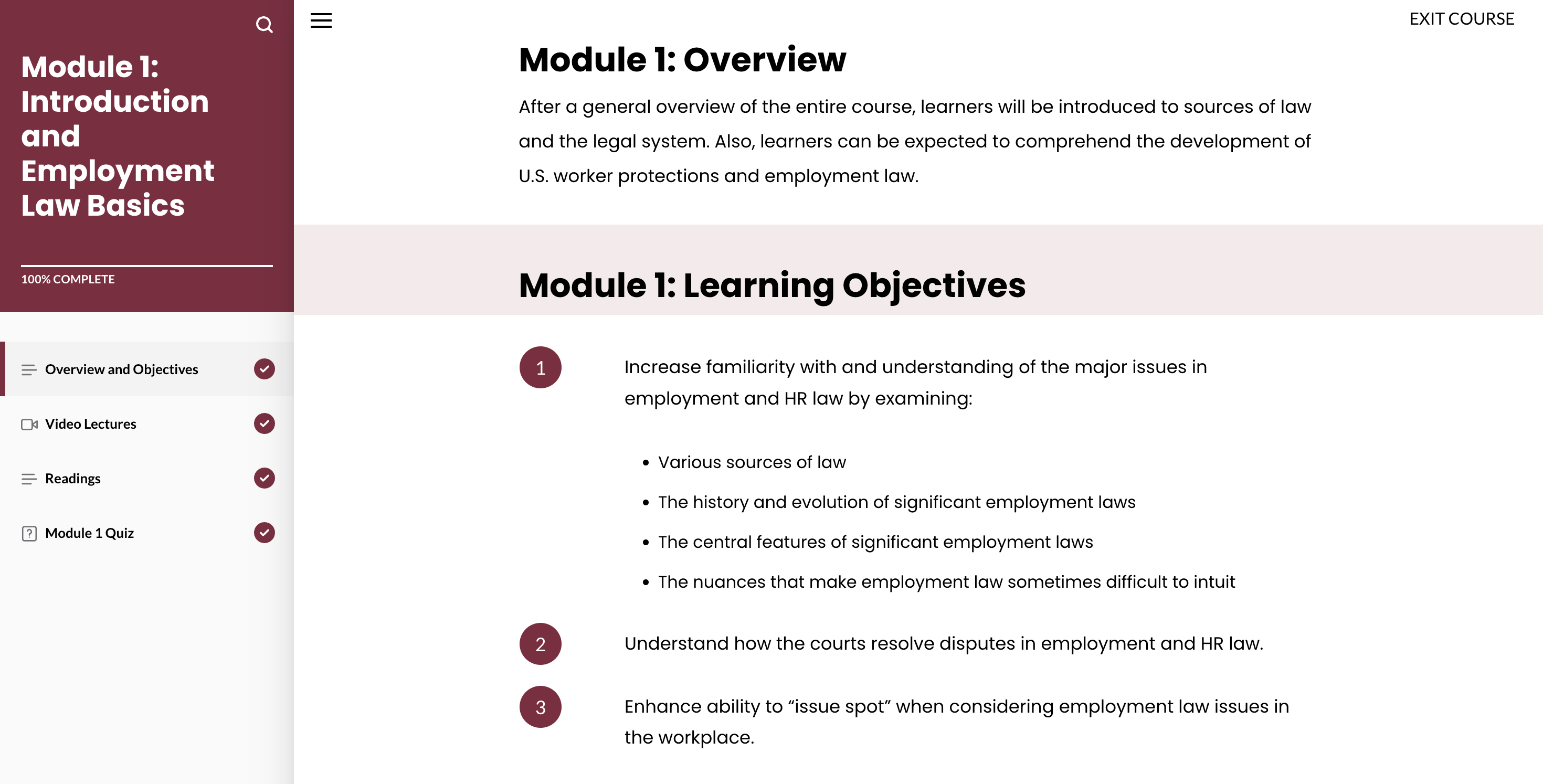
Rise 360 lesson showing the Module 1 overview and three numbered learning objectives, with a lesson menu listing Overview and Objectives, Video Lectures, Readings and Module 1 Quiz
Each module opens with an overview and measurable learning objectives, followed by video lectures, readings and a quiz.
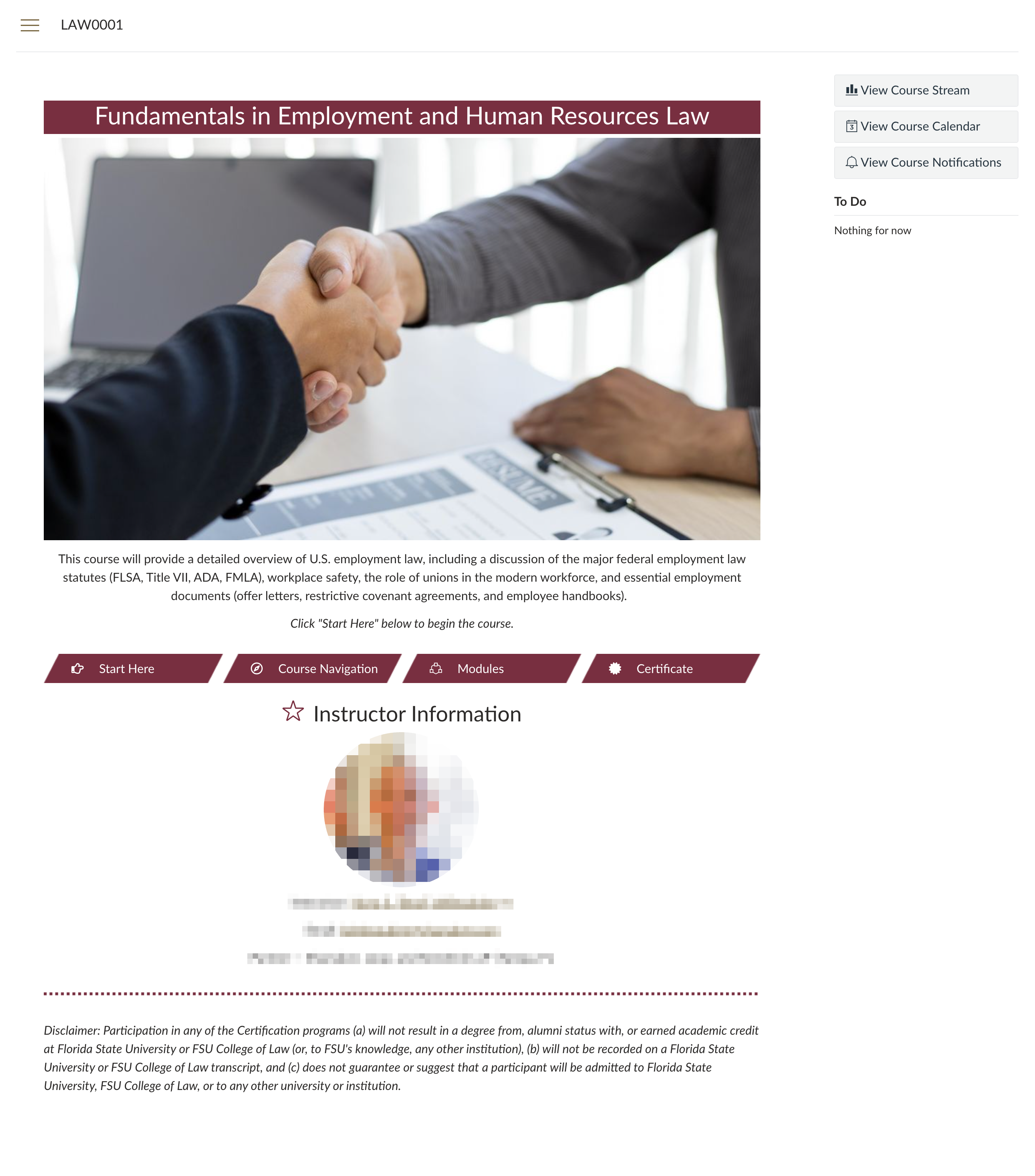
Canvas course home page with the course title banner, course description and Start Here, Course Navigation, Modules and Certificate buttons
A course home page gives learners one clear starting point.
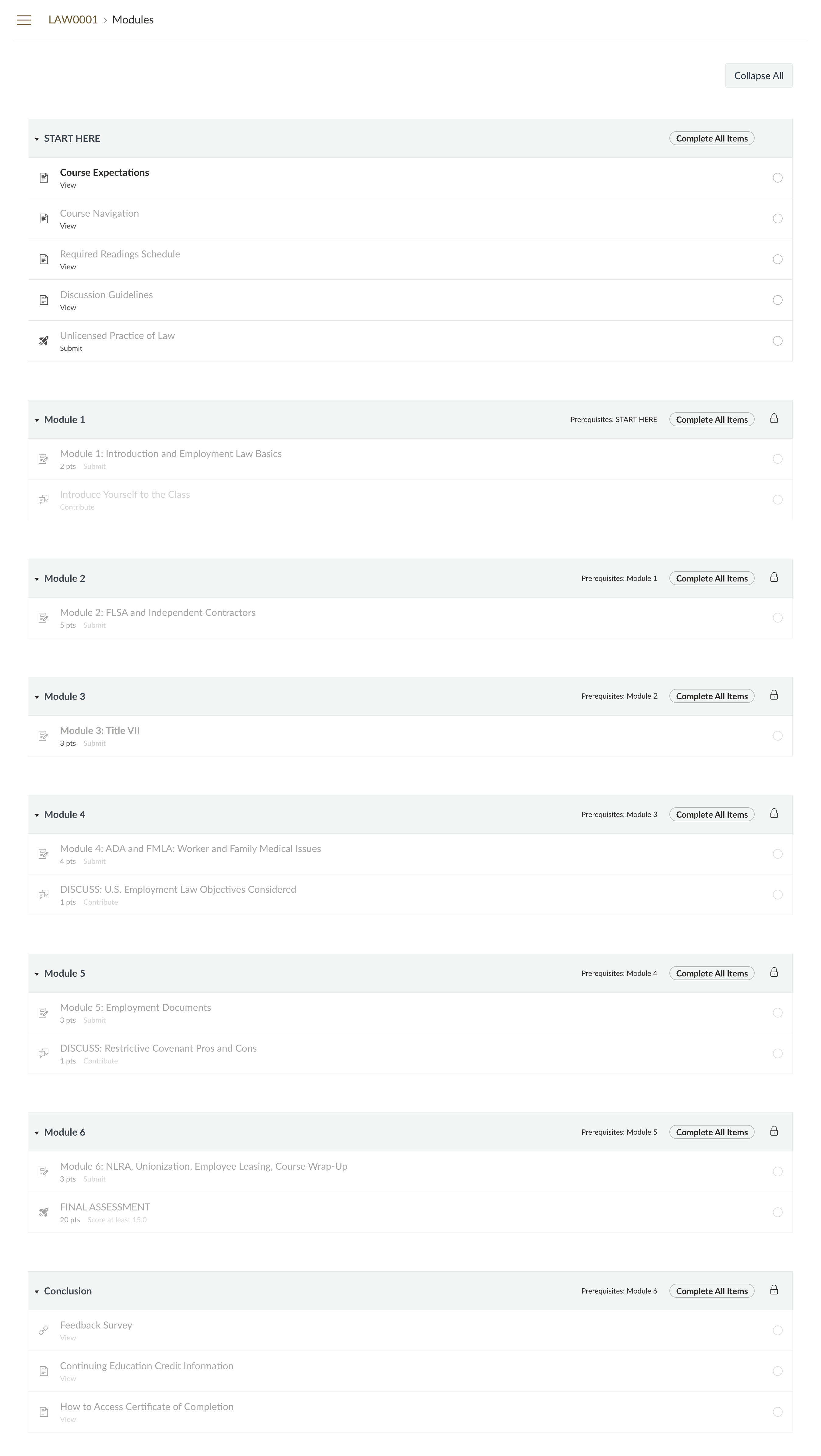
Canvas modules list showing Start Here, Modules 1 through 6 and a Conclusion module, each locked until the previous module is complete
Modules unlock in sequence as learners complete each one.

Format

Executive Education | Fully Online | 6 Modules

Role

Instructional Designer

Tools

Articulate Rise 360, Canvas LMS, Adobe Premiere Pro, Microsoft PowerPoint

Program

25+ fully online, accredited courses serving legal and business professionals

Overview

This course is part of FSU College of Law's Stoops Center executive education program — a portfolio of 25+ fully online, accredited courses serving legal and business professionals. As the sole instructional designer on this program since 2022, I have continuously iterated and expanded the portfolio. This course represents my standard design approach applied consistently across the full program.

Learner Feedback (2025)

overall satisfaction
4.88 / 5
instructor expertise
4.94 / 5
clarity and relevance of content
4.82 / 5
navigation and ease of use
4.88 / 5
of respondents would recommend this course
100%

My Process

  1. Analysis

    For each course, I define the learner profile — typically working professionals seeking to expand their legal or business knowledge — and determine appropriate learning activities based on content complexity and audience needs.

  2. Design

    Early in my tenure, I audited Canvas's native capabilities and third-party features to establish a scalable, standardized course structure. After building a business case for Articulate Rise 360, I restructured courses to increase engagement while maintaining continuity for learners already enrolled in the live program. I use the Quality Matters rubric to guide course formatting, so objectives, assessments, materials and navigation align in every course.

  3. Development

    Each course is built across two environments — Canvas serves as the delivery and assessment layer, housing discussion boards, quizzes, reading libraries, and SCORM packages; Rise houses the core content, including video lectures, knowledge checks, and module overviews. Courses run 4-6 modules with 45-60 minutes of chunked video instruction per module organized by topic.

  4. Implementation

    Courses are delivered through Canvas Catalog with rolling enrollment. Each completion earns a digital certificate and badge, and most courses are integrated into learning pathways that lead to program-level certification.

  5. Evaluation

    Learner feedback is collected through an optional end-of-course survey. I also deploy a longitudinal survey at least 60 days post-completion to gauge how learners are applying the material on the job — an important consideration given that traditional cohort-based analysis isn't feasible in a rolling enrollment model.

  6. Accessibility

    All courses meet WCAG 2.2 standards. Videos are captioned, images include alt text, and PDFs are screen-readable. I conduct ongoing accessibility audits and implement updates as the portfolio evolves.

  7. SME Collaboration

    I work directly with practicing attorneys and subject matter experts to ensure content accuracy. Given the demands on SMEs' time, I establish clear timelines for accountability and structure their involvement around focused review tasks — primarily assessment questions, readings, knowledge checks, and discussion prompts — rather than full course review.

Completion Credentials

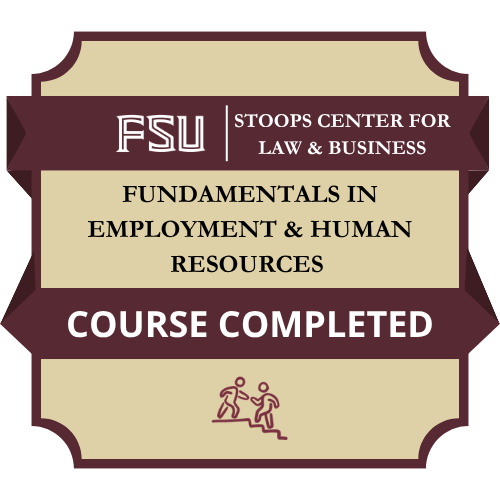
Digital badge reading FSU Stoops Center for Law and Business, Fundamentals in Employment and Human Resources, Course Completed
Learners earn a verified digital badge on completion.
Sample Florida State University certificate of completion for the Professional Certification in Fundamentals in Employment and Human Resources Law
A Professional Certification is awarded after the final assessment.

Available Credits

  • 16SHRM Professional Development Credits (PDCs)
  • 4.5HRCI HR (General) Credits
  • 5.0CLE Credits by The Florida Bar
  • 4.5North Carolina State Bar CLE
  • 4.5California State Bar CLE
  • 4.5Texas State Bar CLE
All work

Concept eLearning · Rise 360

Classifying the Stars eLearning

View Project (opens in a new tab)
Course cover for Classifying the Stars

Format

Self-Paced eLearning | Concept Project

My Role

Instructional Designer

Tools Used

Articulate Rise 360, Canva

Overview

This eLearning module introduces adult learners to the basics of star classification using the Hertzsprung-Russell Diagram. The course simplifies a complex scientific concept using visual storytelling, plain-language explanations, and interactive learning elements built in Rise 360.

Highlights

  • Designed a visually engaging and approachable module that breaks down scientific concepts into digestible segments
  • Embedded interactive diagrams, flip cards, and knowledge checks to encourage active exploration
  • Incorporated a pre-test and post-test, allowing learners to measure growth and supporting evaluation of learning effectiveness
  • Applied adult learning principles to support self-paced exploration and retention

Reflection

This project demonstrates my ability to simplify technical content for a general audience and design an intuitive, structured learning experience. Following the ADDIE model, I analyzed learner needs, structured content progression, designed interactive elements, and evaluated the module's effectiveness using pre-test and post-test data. This project demonstrates my ability to apply learning science principles in designing engaging online courses that support measurable improvements in learner outcomes.

Hi, I’m Gabby!

About Me

I’m an instructional designer based in Tallahassee, FL, with a passion for creating clear, intuitive, and engaging learning experiences.

Portrait of Gabrielle Argueta

Background

I'm a Learning Program Manager at the Florida State University College of Law, where I lead the continuing education portfolio for the Stoops Center for Law and Business, a program I built from the ground up. I also work part-time as an Instructional Designer II on the Organizational Development team at Texas A&M University, where I design learning that supports employee and organizational growth.

Before joining the Stoops Center, I supported online course development at FSU's Office of Digital Learning and worked in HR at FSU Information Technology Services. That blend of learning design, HR, and program management shapes how I work: process-driven, learner-centered, and focused on real organizational outcomes.

Education and Credentials

I hold a B.S. in Psychology with a minor in Business and an M.S. in Instructional Systems and Learning Technologies from Florida State University, as well as certifications in Quality Matters, Human Performance Technology, and Change Management.

Expertise

  • Learning Program Management
  • Instructional Design
  • E-Learning Development
  • Learning Experience Design
  • Project Management
  • User-Centered Design
  • Multimedia Integration
  • Learning Operations

Tools

  • Rise 360
  • Storyline 360
  • Canvas LMS
  • Microsoft Suite
  • Google Workspace
  • Asana
  • Canva Pro
  • Qualtrics
  • Power BI
  • iSpring Suite
  • ElevenLabs
  • Skybox AI
  • Synthesia
  • Claude
  • ChatGPT
  • Copilot

Fun Facts

  • Big Sister

    I volunteer as a Big Sister with Big Brothers Big Sisters of America.

  • Park painter

    You can find me painting in the park.

  • Concert outfit planner

    I bring the same creativity and intentionality to planning a concert outfit as I do to designing courses, even when working under tight deadlines.

  • Long walks

    Long walks are how I reset and think through ideas.

  • Fashion lover

    Fashion is one of my favorite creative outlets.

  • Cat mom

    I spend my downtime with my cat, Meeko.